


Buddhadharma

Although the Buddhadharma is incredibly extensive and broad in philosophy, practices and application; in traditions, lineages and orders, we can yet structurally understand it in three fields and categorize the wealth of all transmissions threefold. This triad is universal for all traditions.
Chöje Lama Palmo seeks to make Buddha Shakyamuni’s treasures available to her disciples so they grasp and understand, as well as to give them a proper overview for clarity and understanding, an anchor on their personal path of the Buddhadharma which enables them to classify the broad variety of teachings. Additionally, her instructions are very precise and clear, in a fresh new language.
Our teaching- and practice program is marked in this light.
The sacred triad
The art of actually knowing the three important constituents of the Buddhadharma; to understand, apply and put into action in daily life in order to become a true dharma disciple.



The Three Pillars of confidence
The Three Pillars of trust; Buddha, dharma and sangha, are the pillars on our personal path of Buddhadharma. We entrust ourselves to them in understanding and direct experience and understand them as temporary support ensuring our safe individual development to eventually become Buddha ourselves.
The aim of the Buddhadharma is hence not to produce followers, devotees or scholars, rather its only purpose is to guide students to actively turn their minds outside in and become.


Dharma student versus dharma disciple
Years of affiliation in mind don’t make for a disciple-hood. Often dharma disciples and dharma students are being confused although they are fundamentally different.
Interest doesn’t make us a dharma disciple, refuge alone is insufficient.
 A dharma student is someone who interestedly listens to dharma teachings; out of interest or curiosity, just as you would at university. They do not actively put the teachings into action and let their continuum spiritually ripen.
That is completely o.k. You are a dharma student but you can at any given time emerge into a dharma disciple.
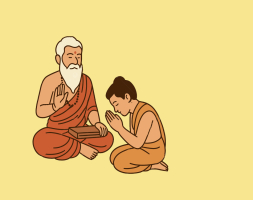
One becomes a dharma disciple by applying the teachings in personal meditative immersion and spiritual practice which enables us to transform our habitual tendencies and become true disciples.
The first step is the so-called refuge. Often, dharma disciples end their spiritual path right after having taken refuge which technically makes them dharma students again who seek teachings out of interest and curiosity.